
The Pouring Calm: Exploring Shirodhara as a Path through Depression
In our fast-paced, hyper-connected world of 2026, the mental health crisis has reached a staggering peak. While pharmacological interventions like SSRIs and modern psychotherapy remain the gold standard in Western medicine, a growing number of individuals are looking backward to move forward. They are turning to Ayurveda, the 5,000-year-old “Science of Life,” and specifically to a treatment that looks like a ritual and feels like a rebirth: Shirodhara.
If you have ever felt the heavy, suffocating blanket of depression—where the world loses its color and your mind feels like a browser with too many tabs open—Shirodhara offers a unique, physiological bridge to mental clarity.
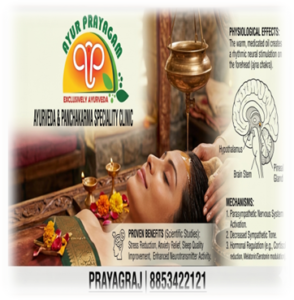
What is Shirodhara?
The word “Shirodhara” is derived from two Sanskrit words: shiro (head) and dhara (flow). At its simplest, it is the process of pouring a continuous, warm stream of liquid—usually herbalized sesame oil, buttermilk, or medicated water (qwath)—onto the forehead, specifically targeting the “third eye” or Ajna Chakra.
But to describe it as just “pouring oil” is like describing a symphony as “making noise.” It is a sophisticated therapy designed to induce a state of sustained sensory deprivation and neurological recalibration.
The Ritual Process
- Preparation: The patient lies on a carved wooden table (Droni).
- The Stream: A copper/frp/mud vessel hangs above 4 angulas of the brow. A steady, rhythmic flow of warm oil is directed at the space between the eyebrows.
- The Oscillation: The practitioner gently to and fro swings the vessel, ensuring the oil moves across the forehead in a pattern that mimics the natural rhythms of the nervous system.
- The Duration: This continues for 45 to 60 minutes or as minimum can patient feel calm, followed by a period of silent rest.
Understanding Depression Through the Ayurvedic Lens
In modern medicine, depression is often viewed through the lens of neurotransmitter imbalances—specifically serotonin, dopamine, and norepinephrine.
In Ayurveda, depression (often referred to as Vishada or Manasada) is seen as an imbalance of the three Doshas: Vata, Pitta, and Kapha.
- Vata-type Depression: Characterized by anxiety, insomnia, and scattered thoughts. It feels like “wind”—unsettled and fearful.
- Pitta-type Depression: Characterized by anger, frustration, and a sense of failure. It feels like “fire” that has burned out into ash.
- Kapha-type Depression: The most common form, characterized by lethargy, heaviness, excess sleep, and a feeling of being “stuck in the mud.”
Shirodhara is the ultimate “balancer.” The warmth and weight of the oil ground the flighty Vata, the cooling herbs soothe the irritable Pitta, and the rhythmic flow breaks the stagnation of Kapha.
The Science of the Stream: How it Affects the Depressed Brain
You might wonder: How can oil on my forehead change my brain chemistry? The answer lies in the intersection of ancient wisdom and modern neuroscience.
1. The Vagus Nerve and the Parasympathetic Shift
Depression often keeps the body in a state of chronic “freeze” or “low-level flight.” Shirodhara stimulates the pressure receptors on the forehead. These signals travel via the trigeminal nerve to the brainstem, activating the Parasympathetic Nervous System (PNS). When the PNS takes over, the heart rate drops, cortisol (the stress hormone) plummet, and the body finally believes it is safe.
2. The Alpha and Theta State
Neurological studies using EEGs have shown that during Shirodhara, brain waves shift from the frantic Beta waves (associated with stress and rumination) to Alpha and Theta waves.
- Alpha waves are the gateway to the subconscious and are associated with “flow states.”
- Theta waves are usually only found in deep sleep or profound meditation.
For a person with depression, whose mind is often a cage of repetitive negative thoughts, this shift provides a rare and much-needed “reboot.”
3. Impact on the HPA Axis
The Hypothalamic-Pituitary-Adrenal (HPA) axis is the body’s central stress response system. In depressed individuals, this axis is often deregulated, leading to a permanent state of inflammation. The cooling and rhythmic nature of Shirodhara acts as a “thermal and mechanical regulator,” quieting the HPA axis and reducing systemic inflammation, which 2026 research increasingly links to depressive symptoms.
Beyond the Physical: The Emotional Release
One of the most profound effects of Shirodhara on depression is what practitioners call Srotas cleaning—the clearing of mental channels.
Depression is frequently a result of “undigested” emotions—traumas or grief that we haven’t been able to process. During the deep silence of a Shirodhara session, these suppressed emotions often bubble to the surface. It is not uncommon for patients to weep quietly or experience vivid “waking dreams” during the treatment. This is not a sign of the treatment failing; it is the “digestion” of emotional toxins (Ama).
“Shirodhara doesn’t just treat the symptoms of a heavy heart; it provides the silence necessary for the heart to speak.”
Comparing Shirodhara to Modern Treatments
While I would never suggest replacing a doctor-prescribed regimen with oil alone, it is helpful to see how Shirodhara complements modern approaches.
| Feature | Modern Antidepressants | Shirodhara Therapy |
| Mechanism | Chemical alteration of synapses | Neurological & Energetic grounding |
| Side Effects | Weight gain, lethargy, libido loss | Minimal (mostly oily hair!) |
| Onset | 4–6 weeks | Immediate relaxation; cumulative mood shift |
| Experience | Passive (taking a pill) | Holistic (sensory immersion) |
What to Expect: A Typical Course for Depression
If you are seeking Shirodhara specifically for depression, a single session—while lovely—is rarely enough. Ayurveda emphasizes accumulation.
- The Intensive Phase: Usually, a series of 7, 14, or 21 consecutive days is recommended. This “floods” the nervous system with stability.
- The Choice of Liquid: For depression, Ksheeradhara (medicated milk) or Takradhara (medicated buttermilk) is often used because it is cooling and helps lift the heavy “fog” of Kapha.
- Post-Treatment Care: It is vital to avoid screens, loud noises, and cold wind for at least two hours after a session. The “Third Eye” is metaphorically open and sensitive.
The Practical Challenges: What to Know Before You Go
Before you run to the nearest Ayurvedic treatment center, there are a few things to keep in mind:
- The Oil Factor: You will be very oily. Most practitioners recommend leaving the medicated oil on your scalp for several hours after the session. Bring an old hat or a scarf you don’t mind ruining.
- The “Healing Crisis”: Occasionally, after the first session, you might feel a temporary increase in fatigue or emotionality. This is often the body beginning to release long-held tension.
- Contraindications: Shirodhara is generally not performed if you have a fever, a heavy cold, or are in the final stages of pregnancy.
The Future of Mental Health: Integrating the Old and New
As we look at the landscape of 2026, the most successful mental health journeys are “Integrative.” They involve the precision of Western diagnostics and the profound, soul-level comfort of Eastern therapies.
Shirodhara offers something that a prescription bottle cannot: The experience of being held. In a world that demands we always be “on,” the act of lying still while a warm stream of oil washes away the day’s noise is a radical act of self-love. It reminds the depressed mind that peace is not just a concept, but a physical possibility.
Final Thoughts
If you are struggling with depression, know that your brain is not “broken”—it is likely just overwhelmed and out of rhythm. Shirodhara isn’t a magic wand, but it is a powerful metronome. It helps your nervous system find its beat again.
Whether you see it as a spiritual ritual or a neurological intervention, the result is the same: a lighter heart, a clearer mind, and a moment of profound, liquid peace.
AYUR PRAYAGAM always happy to see our patients free from this slow progressive disorder.
Early diagnosis is key of success.
BY- DR. VIJAY P SINGH
M.D (Panchakarma)
Visiting consultant at AYUR PRAYAGAM